Jan Fabre
Searching for Utopia
10.05.2003 - 28.09.2003
Zeedijk 635 - Knokke
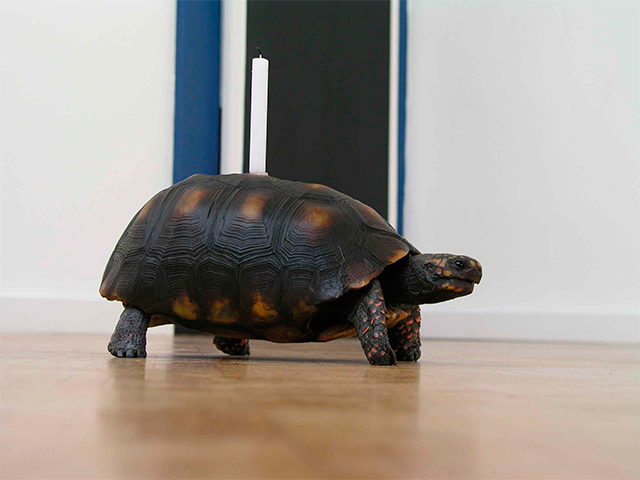
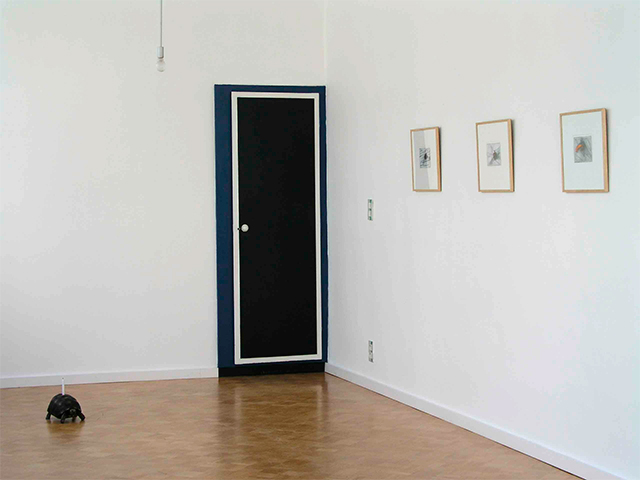
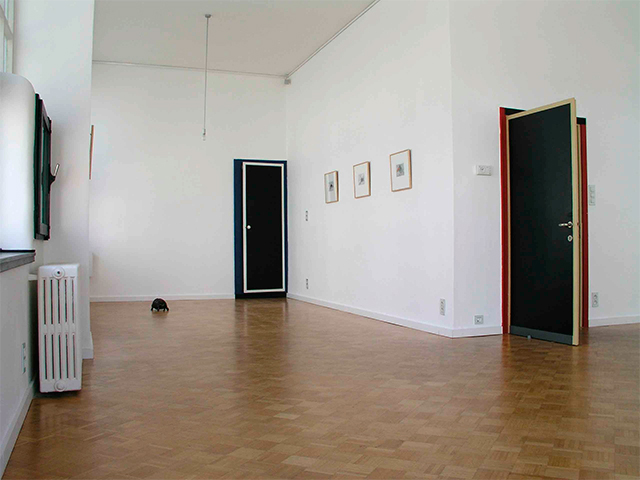
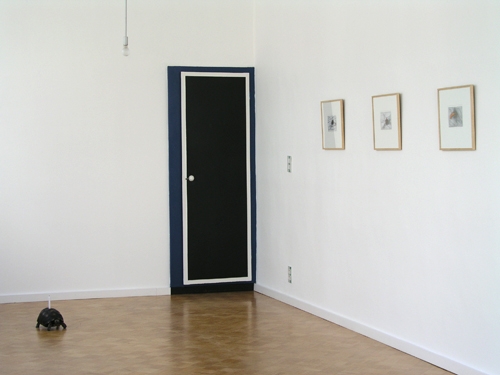
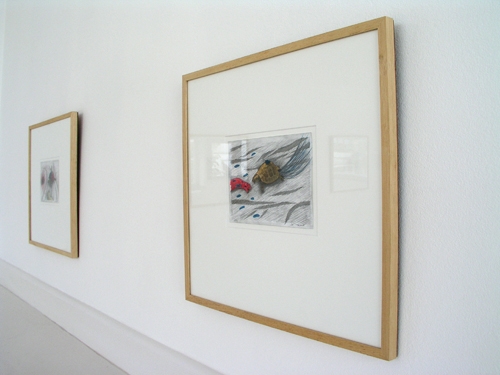
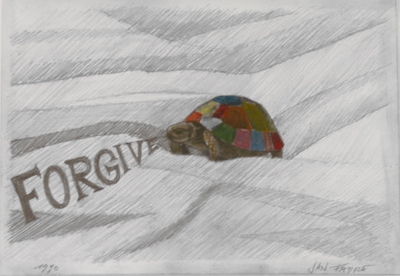
During the summer months, the Zwart Huis exhibits the most recent work of the Antwerp artistic all-rounder Jan Fabre. The exhibition consists of living turtles and drawings, sculptures, installations, each of which focuses on the turtle motif. The works date from the late 1970s to the present.
Their presentation ties in with Fabre's creation of Searching for Utopia, a bronze sculpture that he created as part of the 2003 Beaufort art project, and which stands on the beach of Nieuwpoort. The sculpture represents a female sea turtle, with the artist himself on her back, reins in hand. The animal world continually appears in Jan Fabre's oeuvre in all sorts of forms. Beetles and owls are well-known and frequent sparring partners of his imagination, but parrots, frogs, walking leaves, praying mantises, fish, bats, spiders or flies also figured in his artistic universe on one or more occasions. The turtle has operated rather in the shadows up to now. Its sudden appearance on the Belgian coast therefore raises questions.
The exhibition in the Zwart Huis traces the forms, roles and meanings that the animal assumes or embodies in Fabre's oeuvre. This shows that the turtle is an excellent "Warrior of Beauty and Despair".
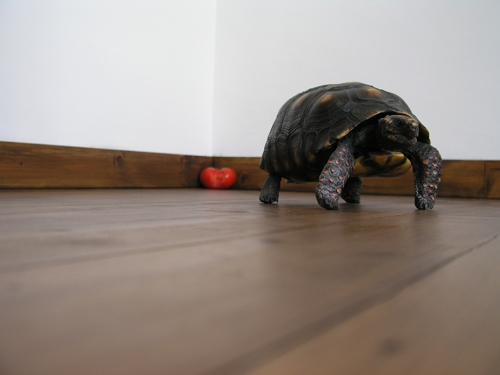
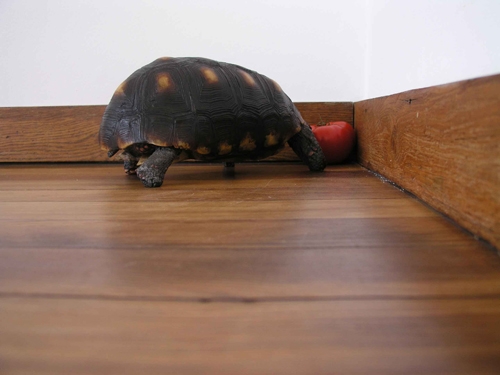
In an 8mm black-and-white film from 1978, Jan Fabre gives one of his pets, Mieke the tortoise (a Greek tortoise), a large fresh tomato. Every time Mieke tries to bite it, the tomato slides away because the skin of the fruit is too tight and slippery for her mouth. In a diary entry, Fabre writes:
“But Mieke never gave up. I noticed that she pushed the tomato towards the corner. When the tomato was finally in the corner, she kept pushing her head against the tomato in her house, until the skin of the tomato wrinkled, so that her mouth got a grip, to bite into the tomato. And then the party of the Greek heroine began. The tomato was half eaten in one sitting.”
Fabre writes this in his diary on 27 July 1982, during the rehearsal process of the stage production: "It is theatre as could be expected and foreseen. He shows the film to his actors and dancers. The intention is that during the rehearsal process they will bend the laws of time and movement, repetition and discipline to their will, to explore and shift their mental and physical boundaries in such a way that they will be reborn and rise in a new form. Through concentration and elimination they can arrive at an essence, really live in their bodies and become a sign of their personality and individuality. Ultimately, the dancer/actor becomes a Warrior of Beauty, as persistent and brave, funny and intelligent as Mieke, the Greek heroine."
The turtle is one of the oldest primal forces and animals that inhabit the earth today. In the time of the dinosaurs, the heyday of reptiles (around 230 to 70 million years ago), giant ancestors of the turtles walked the earth. The turtle survived the demise of the dinosaurs, and in its current form, thanks to its exceptional adaptability and perseverance, it has survived for the last 150 million years. This makes it three times as old as modern mammals and more than 3,000 times as old as homo sapiens. The 21st century turtle hardly differs in appearance from its fossil, ancient ancestors. Even in its current form, it remains an unusually tough animal that can survive a few days without oxygen and several months without food. This extremely remarkable creature, with its impressive armor, robust head and scaly legs, embodies a memory that makes our history sink into nothingness. In this sense, the turtle is very similar to the beetle, another successful armored warrior that has defied the millennia. No wonder that the turtle, as the protagonist of myths and rituals, has nourished the memory and imagination of so many civilizations. In the Hindu kingdom, when a great flood dissolves the earth once every four billion years, the god Vishnu takes the form of a great turtle, carrying on its back the vessel in which gods and demons mix the elements needed to recreate the earth. To this day, the marsh turtles that live in the waters around the Buddhist shrine of Wat Po (Bangkok) are seen as symbols of immortality, as temporary homes for human souls as they travel through successive rebirths on the path to nirvana.
The turtle is an intermediate creature, possessing both an external (like insects) and an internal skeleton (like almost all reptiles, birds and mammals). This is an excellent physiology for survival in Jan Fabre's universe, which reflects both the dazzling beauty and the blind hardness of nature - and of our current civilization. The turtle's spine and ribs are completely fused to the shell. As a result, the turtle looks a bit like a medieval knight in hopelessly heavy armor, only able to move his legs, neck and tail. However, one should not be misled by its apparent clumsiness and slowness. Most turtles are agile, strong climbers or swimmers, and what they lack in speed they make up for in instinctive intelligence, perseverance and endurance. Charles Darwin noted during a stay on the Galapagos Islands:
“When the tortoises make a deliberate move to a certain point, they travel both day and night, and reach their destination much sooner than one would expect.”
The hare in the famous fable by the Greek poet Aesop experienced it first-hand.
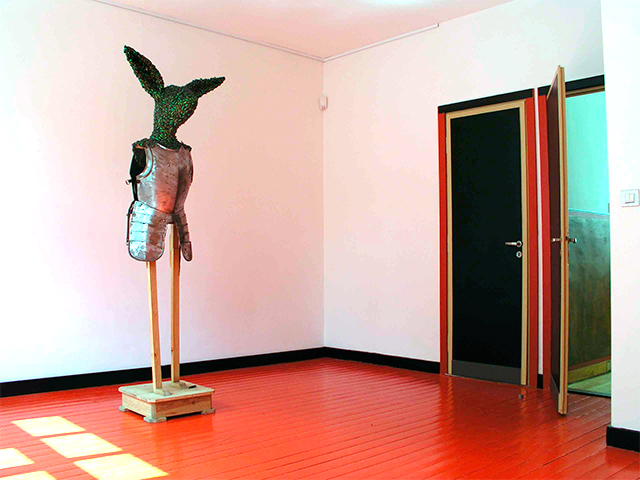
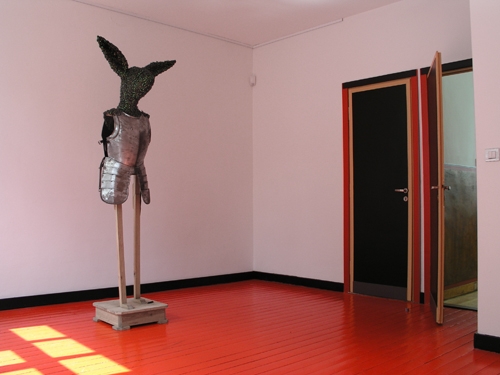
Like any brave warrior, the turtle is also vulnerable. While the male sea turtle remains at sea for the rest of its life, the female sometimes swims hundreds of miles to the beach where she was born, where she drags herself beyond the high tide line with all her strength. There she digs a hole and lays her eggs. While doing so, she is so focused – in a trance, as it were – that she is unaware of what is happening around her. Birds of prey, coyotes and people sometimes take advantage of this to attack her or her nest. After laying the eggs, the mother covers the nest and returns to the sea. When the newborn sea turtles clamber out of their nest and then run en masse and headlong to the sea, they are awaited by the same hungry predators, and if they survive the rush, it is a mystery how they manage to survive. It is believed that one in a thousand hatchlings survives to sexual maturity. Some species, such as the tortoises on the Galapagos Islands, live up to 150 years, but even these old animals almost all meet a fatal end, for example by falling into an abyss. Warrior of Beauty, Warrior of Despair. The sculpture with that title, also called Flemish Warrior and created in 1996 by Jan Fabre, consists of a head of swarming jewel beetles, the breastplate of a medieval suit of armor and a pair of wooden legs. The Warrior of Despair has the ears of a Flemish Giant and the snout of a tortoise.
The turtle is an absolute master of metamorphosis, another central requirement for coping with the strict laws of Fabre's universe. It has no teeth; instead, it has jaws with a sharp cutting edge, giving it a kind of bird's beak. When it withdraws its head and legs under its shell, shutting itself in its home, it becomes as immobile, strong and impenetrable as a piece of rock – it becomes rock. The lines on its shell, a kind of annual rings from which the successive stages of the shell's growth can be read, make it resemble a tree trunk. The magnificent patterns with which the shell is adorned often take the form of topographical lines on a map (there is even such a thing as a 'map turtle'). For many North American Indian tribes, the land on which they lived was the back shell of an enormous 'mother turtle', floating in a vast primeval sea. In the ancient Greek oracle of Delphi, turtles served as oracle stones. Warriors came to decipher the drawings in the ‘stones’ to draw up strategies before they went to battle. In this way, the turtle is also part of the origin and genesis of language and image, and consequently of art and science. This belief in the lie of the imagination, in the miracle of the appearance of the image, is a central and recurring element in the art of Jan Fabre. He himself writes about this:
“From the beginning, people saw images. That is why people created their own images. People saw images in a bone, a stone, a piece of wood, in the fire. They saw them in the irregular surface of the rock walls. Science and art are not marginal. They are universal possessions and our most important weapons.”
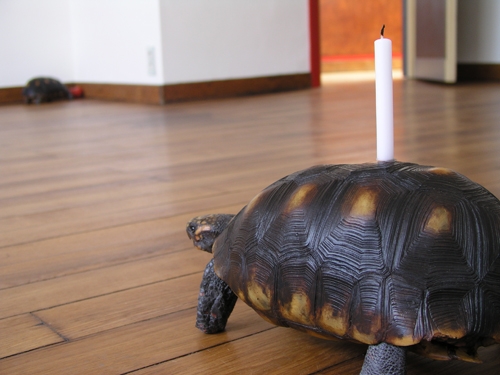
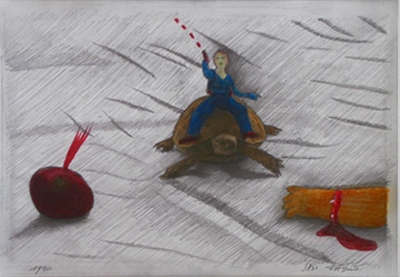
Jan Fabre lets images and signs emerge like monsters from the tangle of thousands of lines in his Bic drawings, from the Rorschach blots of his series of drawings. Several hours, or from the thousands of beetles on the ceiling of the Hall of Mirrors in the Royal Palace. And like a masterful Warrior of Beauty, like a brilliant dancer, the turtle is both thing, animal and body as well as house, image and sign: a brilliant metaphor, an alchemical interplay of spirit and matter, which incarnates the paradoxes of life and death. A pencil and blood drawing from 1982, Radiated Turtle with Oracle Blood, shows a turtle with a shell full of signs, with a number of blood stains above it. The turtle carries a candle on its back, like a beacon in the unspeakable darkness of existence.
In the late 1970s, Jan Fabre performs the Zeno performance. He places candles on the backs of a herd of turtles and organises competitions with them, in which he – just like the warriors in Delphi – gambles on the turtles. The performance evokes, among other things, reflections on time and speed. The unsurpassed master in the inextricable paradoxes of multiplicity and movement is the Greek philosopher Zeno of Elea (5th century BC). In his second paradox of movement, also known as Achilles and the tortoise, he starts from the assumption that space and time are infinitely divisible. Achilles is the most light-footed warrior of antiquity. However, if the tortoise starts with a lead from point B, and Achilles from point A, Achilles can no longer catch up with the tortoise, because when he reaches point B, the tortoise is already at point C, and when Achilles has reached point C, the tortoise is at point D, and so on ad infinitum. On the base of these proofs, not at all devoid of humor but extremely hard to refute, Zeno is considered a forerunner of differential and integral calculus. The Mexican Maya also associated the turtle with mathematical systems.
It is significant, however, that this prehistoric animal remains largely a vague enigma to science to this day. The transparent procedures of Western rationality have no hold on it, despite the dedicated research of Charles Darwin, among others, whose testimony on the giant tortoises in the Galapagos archipelago is as follows: “Whenever I overtook one of these great monsters, which was quietly plodding along, it amused me to see that, as I passed, it would suddenly draw in its head and legs, and, uttering a loud hissing noise, would fall with a heavy thud on the ground as if dead. I would often sit on its back and give it a few taps on the back of its shell, whereupon it would rise and walk along. I had a great deal of difficulty, however, in keeping its balance.” It is believed that most tortoises can hardly hear, but that they use an additional, ‘seismic’ sense, with which they could register low-frequency ground vibrations. How does the sea turtle find its birthplace? How does her unerring sense of direction and masterful navigation function? What happens during the so-called ‘lost years’, when the young sea turtles disappear from view, only to reappear as adults? Even before the ancient Egyptians, turtles were inhabitants of dark waters, the opposites of the sun god Ra. It is precisely from this ancient darkness that the turtle as a metaphor continues to stimulate the imagination and encourage the creation of ingenious interpretations, intriguing stories and powerful images. This is the field in which scientists and artists make new discoveries, and in which Utopia finds its breeding ground.
Searching for Utopia, the bronze statue of the female sea turtle and her rider, cannot be seen separately from the performance that Jan Fabre performed in Lyon in 2001. Dressed in heavy armor and with the head of a mantis or praying mantis on his head, Fabre made drawings with his own blood, which was systematically drained. This resulted in a series of literally blood-curdling drawings, in which stain, image and text are intertwined. One of the texts reads: “There’s no getting used to art. Changing the world is an impossibility. In a world in which everything happens by chance, the artist can at best win a chance victory over chance. Every artist animals for himself, like shipwrecked sailors.”
Van Dale defines Utopia as ‘dream image, unachievable ideal’. Utopia is traditionally located on an isolated island, where the castaway washes up after a disastrous journey. Utopia resides in the imaginary domain beyond the boundary between life and death, but from there it exercises its productive, visual power on anyone who wants to take the chance, who wants to play the game of life and death. Together with the tortoise, Jan Fabre has his gaze fixed on infinity, driven by the desire for the lost years beyond the horizon. Trusting in the ancient sense of orientation and the tortoise's steering skills, he sets off on a catastrophic journey, towards Utopia.
Just before departure, the tortoise and the rider have a 'turtle chat'. Fabre talks about one of his old 'thought models', entitled: The other side is interesting because it is the other side.
"It has the same surprise," he says to the tortoise, "as when you walk behind a woman and think, based on the view from the back, that she is young, beautiful and attractive. Until you pass her and see the front."