Koen Wastijn
Koen Wastijn (b. 1963, Wevelgem, Belgium) is a Belgian visual artist who lives and works in Brussels. Since the late 1980s, he has developed a multifaceted and conceptually layered body of work encompassing sculpture, installation, drawing, painting, and light-based art. His artistic practice is characterised by an inquisitive approach, subtle irony, and an enduring fascination with the complex relationships between humanity, nature, and technology.
In his early work, notably in collaboration with fellow artist Johan Deschuymer, Wastijn explored the boundaries between the organic and the artificial. Themes such as genetic manipulation, reproduction, and the human ambition to shape and control life found expression in sculptures that juxtaposed the familiar with the uncanny. In 1992, Wastijn and Deschuymer were awarded the Prix Pierre-Émile Crowet, a distinction within the prestigious Prix de la Jeune Peinture Belge. This recognition marked a significant moment in his early artistic career.
Wastijn's oeuvre is distinguished by a remarkable freedom of material and form. Bronze, synthetic materials, neon, paper, and a variety of reproduction and transfer techniques form part of his artistic vocabulary. His choice of materials is never merely technical or aesthetic but contributes fundamentally to the meaning of the work. By removing materials and existing images from their familiar contexts, he creates a tension between form and content, recognition and estrangement. His visual language moves between poetry and social critique, formal clarity and conceptual ambiguity.
This ongoing willingness to experiment is reflected in projects and exhibitions such as Rabbits are Batteries, Blind Carbon Copy, Pentagonblues, and This Is No Coincidence. Together, they illustrate the diversity of his practice and his interest in how images are created, reproduced, circulated, and invested with meaning. Beneath the apparent diversity of his oeuvre lies a remarkable coherence: time and again, Wastijn examines how human beings shape, interpret, and seek to control their surroundings.
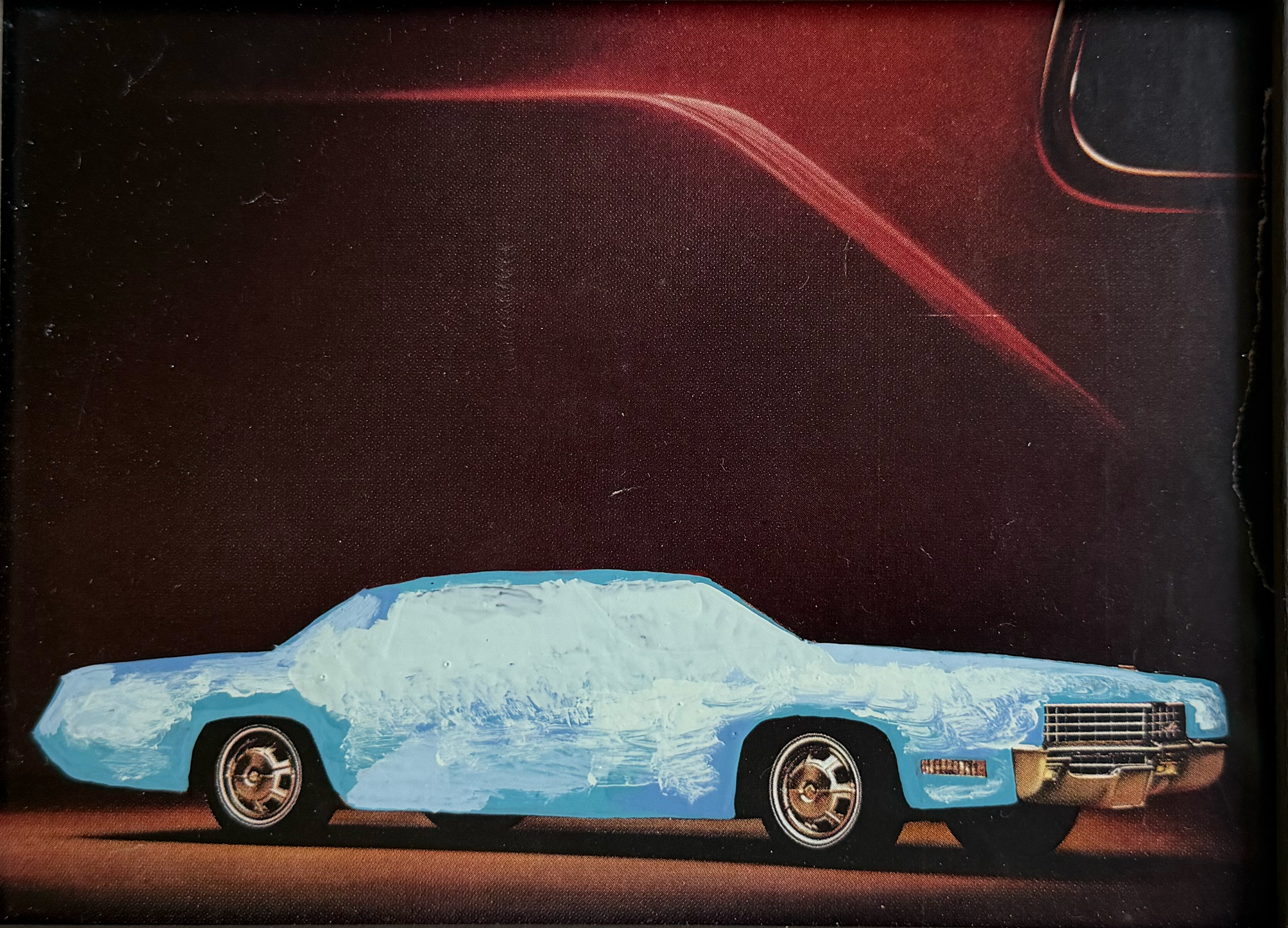
A particularly refined expression of this approach can be found in the Blue Car series (2019–2020). Working with original automobile advertisements from magazines of the 1960s and 1970s, Wastijn meticulously paints over almost the entire photographic surface, leaving only a few details visible as silent traces of the original image. The automobile, once an emblem of freedom, progress, and prosperity, is reduced to an almost abstract, pale-blue apparition. In these intimate and carefully composed works, personal memory and collective history converge. The subtle tension between presence and absence lends the series a distinctly poetic and melancholic dimension. Blue Car thus becomes a contemplative meditation on memory, visual culture, and the promises and illusions of modernity.
His work has been exhibited both in Belgium and internationally, including in Brussels, Paris, Cologne, Madrid, and Sydney. His exhibition history includes participation in L'Empreinte at the Centre Georges Pompidou in Paris (1997), as well as presentations within the context of WIELS in Brussels. His longstanding collaboration with Galerie Zwart Huis has remained a constant throughout his artistic career.
Within Belgian contemporary art, Koen Wastijn occupies an independent and exploratory position. His oeuvre reflects a sustained artistic curiosity and a keen awareness of the paradoxes of our time. Resisting straightforward interpretations, he creates works in which material, memory, imagination, and social reflection converge. His art invites us not merely to look, but to reconsider the ways in which we perceive, understand, and attribute meaning to the world around us.