Peter Lagast, Koen Wastijn, Thierry Grootaers
Houses, Cars & Cigarettes
24.10.2026 - 19.12.2026
- Text
- Gallery views
- Artists: Peter Lagast, Koen Wastijn, Thierry Grootaers
A house. A car. A cigarette. Three everyday things so familiar that we barely notice them anymore. At the same time, they carry with them a whole world of habits, desires and expectations: the house as a place of shelter and security, the car as a symbol of freedom and movement, the cigarette as a pose and a pleasure — and, by now, also as a remnant of another era.
In Houses, Cars & Cigarettes, Thierry Grootaers, Koen Wastyn and Peter Lagast take existing images, objects and familiar motifs as their starting point. They alter, paint over and reposition them. Adding and removing, revealing and concealing continually alternate throughout their work.
For Thierry Grootaers, his immediate surroundings are an important source. Houses, interiors, cars, people, dogs and furniture appear in compositions in which the familiar gradually becomes strange. Figurative scenes are constructed, painted over, erased and intersected by fields of colour. Different perspectives and scales coexist; interior and exterior are not always clearly distinguishable. The image appears familiar, yet resists any unequivocal reading. The house occupies a particular place within this practice. It recurs again and again, sometimes filling the entire image, sometimes appearing as a small, almost autonomous object. It may be a dwelling, an architectural image, a scale model or a doll’s house. Perspective, scale and spatial relationships do not necessarily follow the rules of reality, but rather those of the painting. This ambiguity continues in his sculptures of houses. What in the paintings might still be an image of a model literally enters the physical space here. Yet this does not necessarily make it more real. On the contrary, the scale and constructed form emphasise its character as a model: a house that is simultaneously object, architecture and representation.
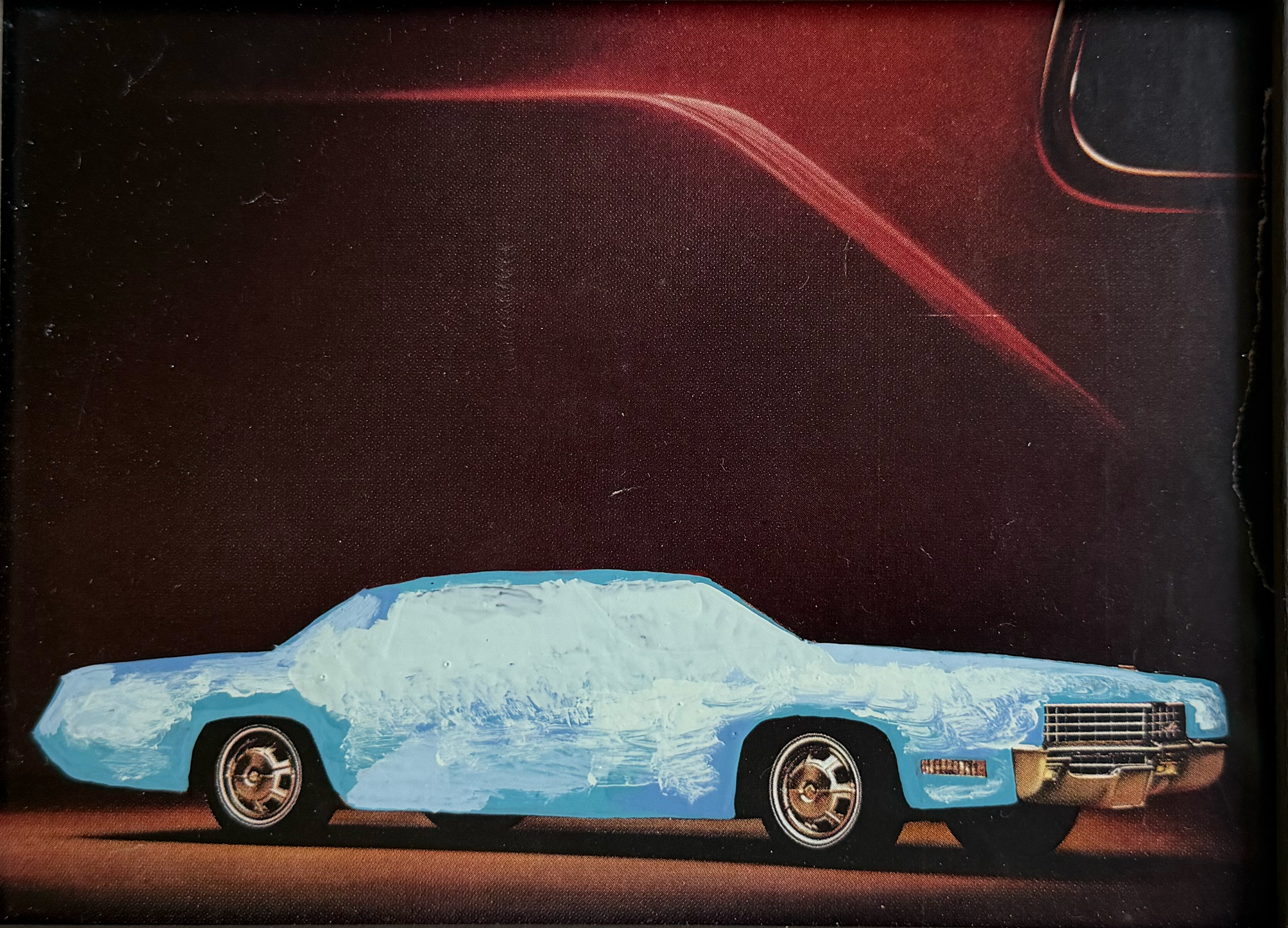
Koen Wastyn takes advertising and magazine photographs of cars from the 1960s and 1970s as his starting point, using these existing images as readymade compositions. The paper, printing techniques and traces of their time remain integral to the work. By painting directly onto these analogue images, Wastyn brings two moments together: the original advertising image and the newly painted layer. Large sections of the photograph are painted over. Human figures disappear, landscapes are reduced to fragments or a distant horizon, and the car itself sometimes becomes little more than a blue field. Other details, however, remain visible. The wheels in particular persist as a stubborn reference to the original image, revealing what lies hidden beneath the paint. In this way, a new ‘script’ emerges from the existing image: the promise of progress, consumption and happiness embedded in the original car photography gives way to a highly reduced and more ambiguous composition. Wastyn does not completely erase the old image, but allows it to remain present through the new painterly intervention. In the tension between photography and painting, visible and hidden, then and now, the remaining elements acquire a new, almost symbolic resonance. In Choicestress, cheerful couples remain as witnesses to a painted-over promise of consumption. In the smaller works from Blue Car, blue-painted cars appear in pared-down miniature scenarios, with only a few sections of the original photograph left visible. In the more recent painted-over posters, the scale increases and the advertising image takes on a more cinematic quality. The car connects the different series and is repeatedly ‘parked’ in a different scenario.
Peter Lagast likewise takes images that already have a history as his starting point. Since 2017, he has used old LP covers as supports for his paintings, a practice that has since become an important part of his oeuvre. Each cover brings with it its own photography, typography, graphic design and visual codes. Lagast responds to these with paint: a detail is highlighted, a section disappears, or an existing element is given a new context through a painterly intervention. The original cover and the added painting remain visible alongside and on top of one another. Sometimes they clash; at other times they merge so naturally that it becomes difficult to determine where the original image ends and the intervention begins. Words, body parts, landscapes and other details can be removed from their original context and become the starting point for a new image. At the same time, the LP cover retains something of its original function and history. It was packaging, graphic design, an advertising image and a carrier of musical identity. Lagast uses precisely this existing visual language as his material. What was once produced in multiples becomes a unique object through the act of painting. The different visual layers continue to coexist, leaving room for new associations and narratives.